Trunk Rattle Never Lies: The Parking Lot Listening Sessions That Still Decide Which Records Drop
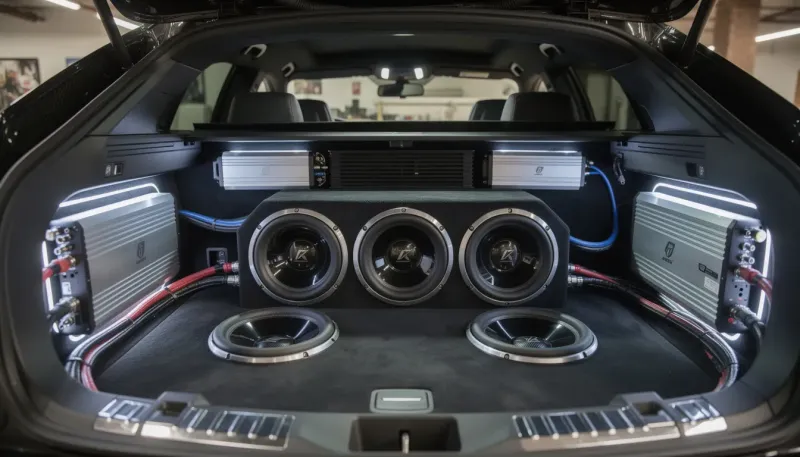
Photo: car subwoofer trunk audio system night parking lot, via images.surferseo.art
There's a strip mall parking lot in every American city where the real mastering suite lives. It's not a room with bass traps and a $12,000 monitoring rig. It's a 2013 Dodge Charger with the trunk stuffed full of subwoofers, idling outside a gas station at midnight, waiting on a WAV file.
If the record doesn't knock there, it doesn't matter what the waveform looks like in Pro Tools. It's back to the lab.
The Test That Never Went Away
A lot of folks outside the culture assume the car audio check died when CDs did. Talk to engineers and club DJs working the underground circuit, and they'll tell you the opposite — it's become more important, not less.
Here's the logic. Streaming platforms compress audio to varying degrees depending on your connection, your device, your volume setting. A mix that sounds wide and clean on studio monitors can turn to mud once it's been transcoded, streamed over LTE, and pushed through a system that's essentially one giant low-pass filter with wheels.
The car is the stress test. It's where the mix either survives or gets exposed.
"I've had records I loved in the studio sound like garbage in the lot," one Atlanta-based engineer told us. "The 808 disappears. The vocal sits on top of nothing. You don't know until you hear it through somebody's trunk."
Why Bass Is the Battlefield
Underground hip-hop lives and dies on low end. That's not news. What's changed is how streaming-era loudness standards have reshaped the low end itself.
Platforms normalize loudness, which means the old volume war — master it louder than the next guy — doesn't work the same way. So engineers have gotten smarter about how they spend their headroom. Heavy sub content that hits hard in a car but stays controlled at normalized levels is the whole game now.
That has real consequences for independent artists mixing on a budget. If your home studio setup doesn't reproduce sub frequencies accurately — and most don't — you're mixing blind in the exact range that decides whether your record knocks.
The workaround? Old school accountability. Play it in the car. Play it in the club. Play it through a Bluetooth speaker at your cousin's cookout. Every system is a different mirror.
The DJ Still Has the Final Word
In most markets, there's still a gatekeeper whose opinion carries weight that no playlist pitch can match: the working DJ. Not the radio personality — the one doing four club nights a week and three private parties on the side.
These are the people who hear how a record interacts with a crowd in real time. They know within eight bars whether the transition from the last song into yours is going to kill the floor's momentum. They know if your snare gets buried when the system's pushed to capacity.
A lot of A&R decisions at the indie level now happen in passenger seats. An artist hands a DJ the file. The DJ queues it up between two proven records. The reaction in that lot — heads nodding, somebody asking "who is that?" — is worth more than any analytics dashboard.
What Artists Getting Tested Should Know
If you're an independent artist about to have your record put through the car gauntlet, a few things separate records that pass from records that get sent back:
- Sub control beats sub quantity. A distorted, runaway 808 sounds worse loud than a tight, tuned one. Tune your bass notes to the key of the track. Every engineer will thank you.
- Leave headroom for the master. If your mix is already slamming at -6 dB, the mastering engineer has nowhere to go. Quiet mixes that get mastered loud always outperform loud mixes that get limited into mush.
- Check the vocal against the low end. In a car, anything below 100 Hz eats everything in its path. If your vocal disappears when the 808 hits, carve space. Sidechain, EQ, whatever it takes.
- Test on multiple systems, not just the good one. A record that only knocks on a $10,000 setup is a record that fails everywhere else.
The Lot Is the New Listening Bar
There's something fitting about it. Hip-hop was born on street corners and in park jams — sound judged by the people standing around it, not by a spec sheet. The parking lot session is that tradition wearing modern clothes.
Streaming changed the distribution. Compression changed the math. But the fundamental question hasn't moved an inch: does it knock?
The trunk still answers first. It's never needed a login to do it.